
time: 15.08.23, 7 -9 pm
GRUND (space): barn
GRUND (reason): phenomenology of the body: feet
texts:
Suzuki Tadashi. Culture Is the Body, translated by Kameron H. Steele, Theatre Communications Group, 2015.;
Maurice Merleau-Ponty, Phenomenology of Perception, 1945, translated by Colin Smith, Routledge Classics, 2002.
workshop concept: Marianna Karava
group: Marianna, Vanja, Eugenio, Ingrid, Giulia, Jasmin, Carina, Andjelina, Fabian, Brigitte
Workshop
„Phenomenology of the body: Grammar of the Feet“
(a concept by Marianna Karava based on the writings of Tadashi Suzuki)
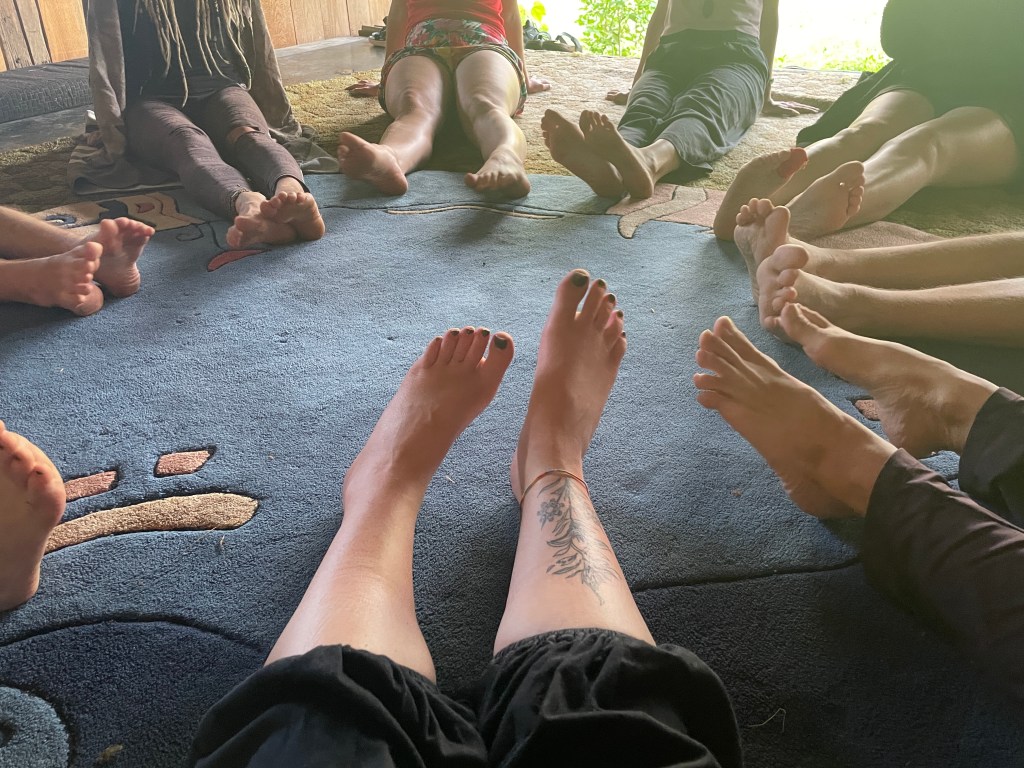
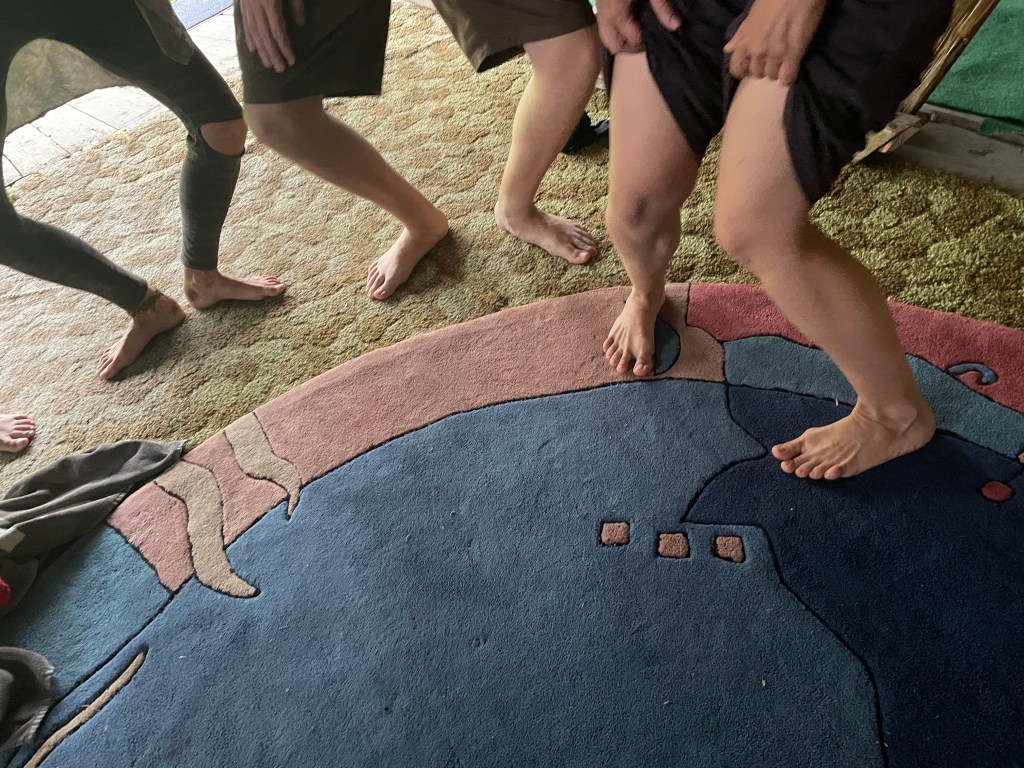
quotes
“I focus on the lower body and especially feet, because I believe that consciousness of the body’s communication with the ground is a portal into a greater awareness of all the physical functions: a point of departure for theatrical performance” (Suzuki, Pg. 65.)
“In ordinary life, we have little consciousness of our feet. The body can stand of its own accord without any sense at all of the relationship of feet to earth; in stamping, we come to understand that the body establishes its relation to the ground through the feet, that the ground and the body are not two separate entities. We are a part of the ground. Our very beings will return to the earth when we die”. (Suzuki, Pg. 69.)
“The feet have provided, up until now, the ultimate means of connection between man and earth” (Suzuki)
“In most housing now … there are no more hallways, no more wooden floors… It is no longer possible to observe [someone] down on all fours with a polishing rag. Vacuum cleaners have become the accepted method for cleaning. Yet the perception that our hands are also the feet, gained from a ‘floor-cleaning’ kind of movement, is an important one. A child who experiences this will understand, even after growing up, that parts of the body other than the feet can have a dialogue with the ground. Why is it, I wonder, that architects have done away with this kind of space altogether.” (Suzuki, Pg. 82.)
“… the feet and hands of modern man have been separated from each other; we have forgotten that mankind is one of the animals. Space is now planned for multiple uses, for its functional possibilities; one is now planned for multiple uses, for functional possibilities; one area often has the same characteristics as another. In trying to construct an ideal living space using this ‘democratic’ concept, spaces are profitably divided into squares – up, down, left, right, front and back, all constructed from the same materials. It is perhaps for this reason that hallways have disappeared.” (Suzuki, Pg. 82.)
“Modern man no longer believes in gods he cannot see; … Any space that – though seemingly useless – could inspire a sense of the sacred, has now disappeared… Even now, if you made a trip deep, deep into the mountains, you would come across spaces that are fenced in but otherwise exhibit no special qualities. However, if you lingered there, some spirit or other might seemingly manifest itself in that space, and you might suddenly find yourself in tears”. (Suzuki, Pg. 83.)
“The phenomenological world is not pure being, but the sense which is revealed where the paths of my various experiences intersect, and also where my own and other people’s intersect and engage each other like gears” (Merleau-Ponty)
“I am the absolute source, my existence dies not stem from my antecedents, from my physical or social environment; instead it moves out towards them and sustains them, for I alone bring into being for myself … the tradition which I elect to carry on, or the horizon whose distance from me would be abolished – since that distance is not of its properties – if I were not there to scan it with my gaze” (Merleau-Ponty)
material

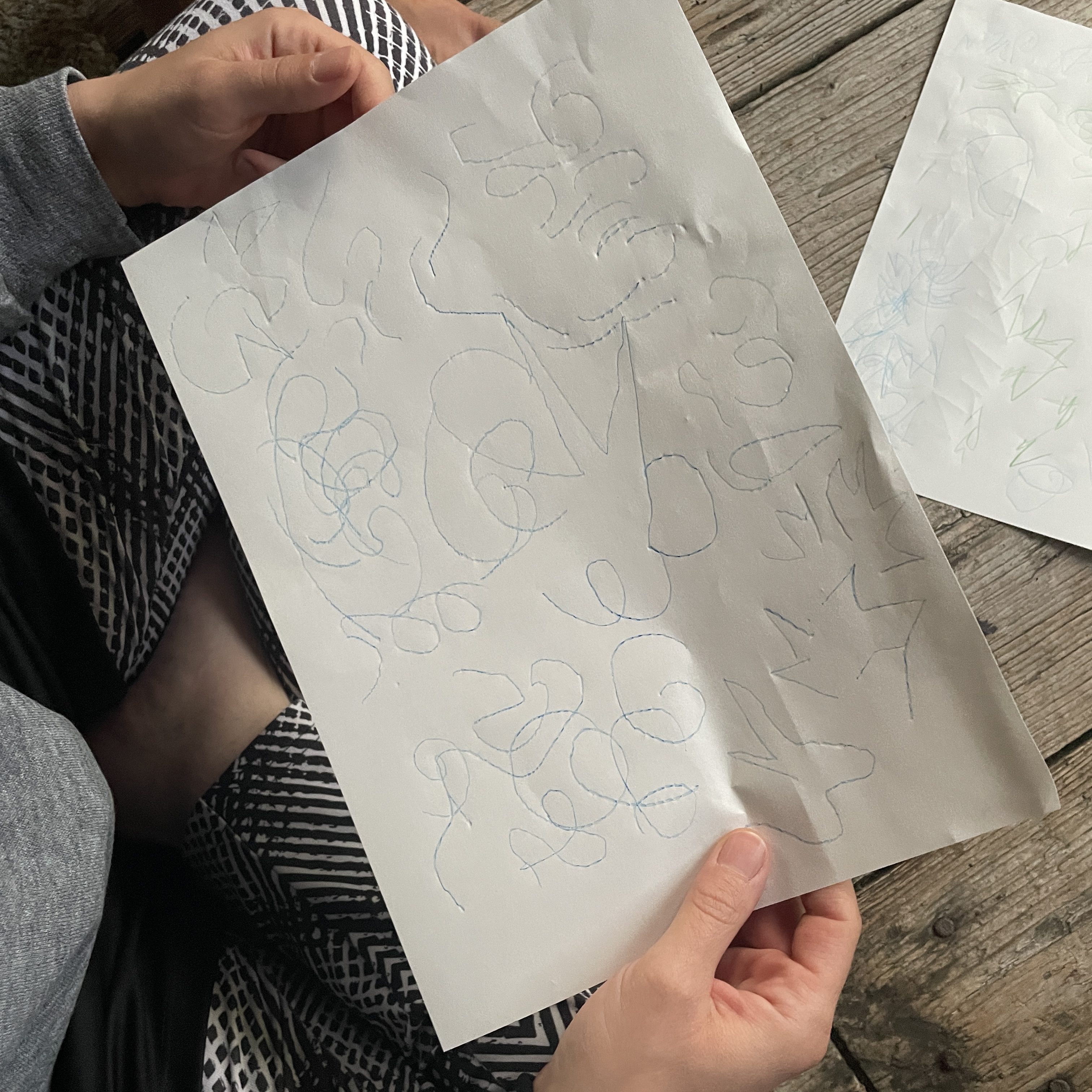
Marianna Karava
is an artist & educator from Greece. Her artistic practice ranges from contemporary dance and performance to poetry and books. Her academic studies include a BA Degree in Biology and a BA Degree in Contemporary Dance. She is a certified Yoga instructor. Her teaching experience includes movement related classes and workshops. As a dance artist she is mainly interested in the practice of dance improvisation and instant composition on stage. As a book artist she is interested in practices related to books as art objects. She has published two art-books as self-publications.
literature
Suzuki Tadashi. Culture Is the Body, translated by Kameron H. Steele, Theatre Communications Group, 2015.
Maurice Merleau-Ponty, Phenomenology of Perception, 1945, translated by Colin Smith, Routledge Classics, 2002.

 grund1535