
time: 01.08.23, 19-23pm
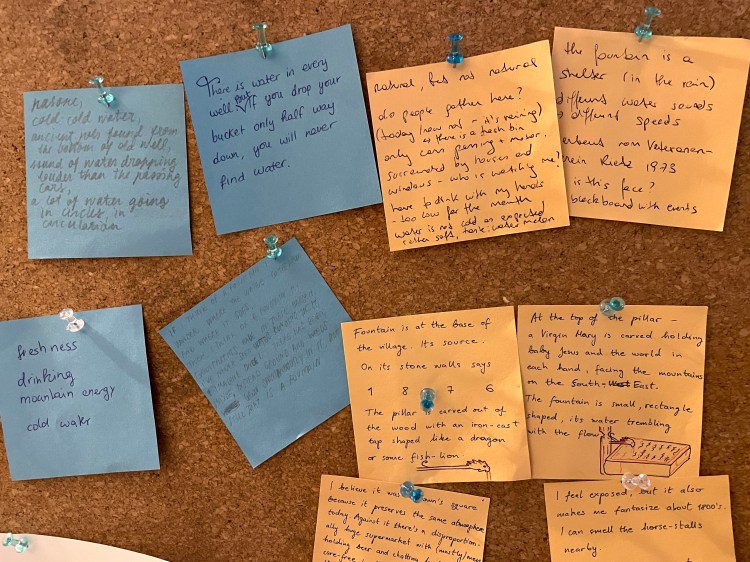
GRUND (space): the barn
GRUND (reason): Introduction to the topic, Roots of Improvisation, Oracle as Improvisational Form, The I Ching – Book of Changes, Roleplay, Storytelling; Residency-Symbol: The Well,
texts:
I Ching : The Book of Changes, 1000-750 BCE, translated by Richard Wilhelm/Cary Baynes, 1950.
Johan Huizinga, Homo Ludens: A Study of the Play-Element in Culture, Angelico Press, 2016.
group: Vanja, Jovana, Marianna, Eugenio, Ingrid, Giulia, Carina, Fabian, Mane, Brigitte
Symbol of GRUND: The Well

“Things keep their secrets”
constant change – eternity – movement – flow – infinity – no beginning, no end
quotes


THE WELL. The town may be changed,
But the well cannot be changed.
It neither decreases nor increases.
They come and go and draw from the well.
If one gets down almost to the water
And the rope does not go all the way,
Or the jug breaks, it brings misfortune.
Thus the well is the symbol of that social structure which, evolved by mankind in meeting its most primitive needs, is independent of all political forms. Political structures change, as do nations, but the life of man with its needs remains eternally the same—this cannot be changed. (#48)
This hexagram applies also to the individual. However men may differ in disposition and in education, the foundations of human nature are the same in everyone. And every human being can draw in the course of his education from the inexhaustible wellspring of the divine in man’s nature. But here likewise two dangers threaten: a man may fail in his education to penetrate to the real roots of humanity and remain fixed in convention—a partial education of this sort is as bad as none—or he may suddenly collapse and neglect his self–development. (#48)
“Time seems to be the dimension about which we have the greatest anxiety”
questions
- „Improvisation“ is quite a modern term, but how far can we go back in history of philosophy to grasp the notion of improvisation?
- How can we use the potential of oracle texts for improvisational purposes?
- What’s your relationship with fountains? Are you aware of fountains in your daily surroundings? What makes the fountain a representative symbol for political power?
- (How) does the well stand as a metaphor for improvisation?
- Play, Improvisation, Ritual, Culture – what’s the relationship like?
material
. . . for a residency-roleplay

In play there is something “at play” which transcends the immediate needs of life and imparts meaning to the action. All play means something. If we call the active principle that makes up the essence of play, “instinct”, we explain nothing; if we call it “mind” or “will” we say too much. However we may regard it, the very fact that play has a meaning implies a non-materialistic quality in the nature of the thing itself.
(Huizinga)
literature
I Ching : The Book of Changes, 1000-750 BCE, translated by Richard Wilhelm/Cary Baynes, 1950.
Heraclitus of Ephesus, Fragments, 500 BCE, translated by Brooks Haxton, Penguin Classics, 2003.
Kenkô and Chômei, Essays in Idleness: and Hojoki, 1244/1431, translated by Meredith McKinney, Penguin Classics, 2013.
Johan Huizinga, Homo Ludens: A Study of the Play-Element in Culture, Angelico Press, 2016.

 grund1535